The Virgin of the Lilies, 1899, William-Adolphe Bouguereau Human life is valuable because it is made in God’s image, therefore: Fertility is a blessing, not a curse There is a reckoning for those who hate life A business of death. Planned Parenthood, along with the other abortion mills in Minnesota and throughout our nation are in the business of death. At this abortuary they do chemical abortions using the abortion pill every Wednesday. Based upon my research they charge between five and seven hundred dollars for that. At other abortion mills where they do later term surgical abortions the price goes up to a couple thousand dollars. In years past we learned that Planned Parenthood, and other abortionists, sell baby body parts and perform experimentation on them, and have even received funding from our government, using our taxes, to do all of these nightmarish things with the bodies of babies. This business of death places a price tag on these lives, and gives them a value of a f...
Get link
Facebook
X
Pinterest
Email
Other Apps
Sermon - Palmarum 2020 - Matthew 21:1-9
Get link
Facebook
X
Pinterest
Email
Other Apps
-
These days many of us are feeling like prisoners, prisoned to our own homes. We’ve been exiled and our freedoms have been lost. Exiled from stores and restaurants, exiled from weddings, funerals, and family reunions, exiled from our church families even. For a long time we’ve taken our freedom as Christians in America for granted, assuming we will always be free to do as we please. But as the past few weeks have made abundantly clear, such is not the case, our freedoms can very quickly be lost when we’re prisoners of fear.
So in these monumental times, let us remember that God “makes nations great, and He destroys them; He enlarges nations, and leads them away.” Kingdoms are like grass that will wither and fade. But, remember God’s promise! “As for you, because of the blood of my covenant with you, I will set your prisoners free from the waterless pit. Return to your stronghold, O prisoners of hope; today I declare that I will restore to you double.” We need not be prisoners of fear, death, nor sin. Rather, we are prisoners of hope and our stronghold is Jesus!
Our readings for Palm Sunday today are very apropos at this time, very comforting and hopeful, reminding us that in the midst of our exile, God will restore us, and so we’re prisoners of hope. Zechariah is one of the most hope filled prophets to read because of when his ministry took place. The 70 years prior to Zechariah’s ministry, Israel had been taken captive by Babylon, Jerusalem and the temple destroyed. But now during Zechariah’s ministry, the Israelites return home to rebuild Jerusalem and the temple. God’s promise of restoring His people back to the temple is finally brought to fruition, even if it took a couple generations of being exiled.
This promise of restoration is for all of God’s people, across all time and space. It doesn’t however mean that we’ll necessarily get our freedoms back and that things will go back to normal immediately or even ever! Afterall, Israel had been in exile for 70 years! I’m no prophet, but I do know that God doesn’t promise comfortable living to Christians on earth. What He does promise is that the King of glory will speak peace to the nations and set us free from our bondage to fear and death! Through the Prince of peace and His covenant of blood, we’re now prisoners of hope.
This One, the Christ, the King of kings and Lord of lords, the Son of David, He has come and rules over all His creation by the power of the cross. This is what the crowds unwittingly celebrated when Jesus came into Jerusalem, fulfilling the words spoken by the prophet: “Say to the daughter of Zion, ‘Behold, your King is coming to you, humble, and mounted on a donkey, on a colt, the foal of a beast of burden.’” Jesus has come, and He came to His people in order to set them free from their exile in this world.
So today we are glad to join in the hymn of the Israelites, as we gladly shout: “Hosanna to the Son of David! Blessed is He who comes in the name of the Lord! Hosanna in the highest!” Save us now, Lord; please rescue us! Come quickly to our aid! Set us free! Blessed are you, Lord Jesus, the hero in this saga!
Truly, Jesus came to do exactly that! He came to save us and free us! But strangely enough, He doesn’t do it at all in the manner we expect. So the longer portion of our reading today comes to us from the crucifixion account of our Lord. Here comes this king, but He doesn’t set up a worldly kingdom, He doesn’t give His subjects a life of luxury, He doesn’t call into active duty His angelic army, rather He silently suffers the mockery of the world.
Normally the Gospels are filled with Jesus speaking, but here Jesus mostly remains silent. He’s accused, mocked, spit upon, stripped, beaten, carries His cross, is nailed to that cross, and then at the end He cries out with a loud voice and yields up His spirit. Dead. With His silent obedience, with His blood pouring down his body upon the dirt, He willingly suffered in order to die so that we might be set free from our prison of sin.
That is the freedom which Christ won for us! Not freedom from our earthly rulers. Not freedom to be happy and successful. Not freedom to be wealthy. Not freedom to eat and drink at the bar. Not freedom to go about our daily business as we so choose. No, our freedom is much more profound and lasting! We have freedom from fear of death, freedom from our sin, freedom from Satan, freedom from every bodily ailment, freedom to be hopeful!
When Christ was crucified, the power of His death to free us from our bondage to death erupted in a sort of first fruits as some rose from the dead on that very day! “And the earth shook, and the rocks were split. The tombs also were opened. And many bodies of the saints who had fallen asleep were raised, and coming out of the tombs after his resurrection they went into the holy city and appeared to many.”
That’s the freedom that Christ has won for you, dear Christian! You’re prisoners of hope! You can’t get away from it! Everywhere you turn as a Christian, you have hope because Christ has set you free from all manner of misery! He has opened your graves! He’s set you free from death! He’s opened the door of heaven!
In this life, you will have many crosses. Lots of things will make you sad and want to cry. We are Christians and we’re like Jesus. Even though Jesus is God, He humbled Himself to the point of death on the cross. He made Himself lower than us, debasing Himself beyond the lowest scumbag sinner, like you and me. He did it out of love for us all. St. Paul tells us to have that mind among ourselves, which is ours in Christ Jesus.
Like Him we will suffer and bear our crosses, lose our freedoms, go into exile as prisoners, and even die. But through all of it, all of life’s trials, we have hope! Hope beyond this present sad reality. We sang of that glorious, joyous, hope in our Hymn of the Day, and so I’d like to close with those words: “Lord, when Your glory I shall see and taste your kingdom’s pleasure, Your blood my royal robe shall be, my joy beyond all measure! When I appear before Your throne, Your righteousness shall be my crown; with these I need not hide me. And there, in garments richly wrought, as your own bride shall we be brought to stand in joy beside you.”
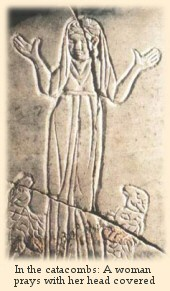
A Defense of Headcoverings in the Lutheran Church by Rev. John Henry Koopman “ Now I commend you because you remember me in everything and maintain the traditions even as I delivered them to you. But I want you to understand that the head of every man is Christ, the head of a wife is her husband, and the head of Christ is God. Every man who prays or prophesies with his head covered dishonors his head, but every wife who prays or prophesies with her head uncovered dishonors her head, since it is the same as if her head were shaven. For if a wife will not cover her head, then she should cut her hair short. But since it is disgraceful for a wife to cut off her hair or shave her head, let her cover her head. For a man ought not to cover his head, since he is the image and glory of God, but woman is the glory of man. For man was not made from woman, but woman from man. Neither was man created for woman, but woman for man. That is why a wife ought to have a symbol of authority on her head, ...
Resurrection of the Flesh , Luca Signorelli, 1502 The Resurrection of Man Intro The body/soul composition of man Death is the unnatural separation of the body from the soul The intermediate state of man Resurrection is the reunion of the body and soul “ There came to Him some Sadducees, those who deny that there is a resurrection. ” Just as today among God’s people, at the time of Jesus there were divisions and distinctions amongst the Israelites. Most well known to us are the Pharisees and Sadducees. Today we see in particular the group known as the Sadducees. The Sadducees were a Jewish sect that flourished right around the time of Jesus. They were wealthy and powerful individuals, primarily made up of high-priestly families and aristocrats who controlled temple worship. Additionally, they were friendly to the Romans and worked with Roman authorities. While the Pharisees were lovers of man-made laws, the Sadducees were more interested in their family heritage. The Sadducees were also...
"My loved one is dying, and the pastor can't come, what do I do?" Over the past few months, nursing homes and hospitals have been closed to visitors, and at times they won't let the pastor come in even when someone is nearing death. What can you do, even when pastor can't come? Read the Bible While it may seem that your loved one is unconscious or asleep, especially since they aren't talking with you and their eyes are closed, however, from my experiences, I've seen hearing improve as death looms closer. Even if they appear to be asleep, it's highly probable they can hear you. So open your Bible and read to them. It will comfort you and them. Some suggested readings: Psalms 6, 22, 23, 32, 38, 51, 102, 118, 130, 143 The passion and resurrection accounts: Matthew 26-28, Mark 14-16, Luke 22-24, John 18-21 Psalm 4:8 Psalm 27:1 Psalm 31:1 Psalm 73:26 Luke 2:25-32 John 3:16-17 John 10:14-28 Isaiah 53:4-5 Luke 23:39-43 John 11:21-27 Romans 14:7-9 2 Corinthian...



Comments
Post a Comment